
NZC – New Zealand Sign Language – Novice

This page provides the draft Learning Languages – New Zealand Sign Language Learning Area.

LearningLanguages-240.png

About this resource

This page provides the draft Learning Languages - New Zealand Sign Language Learning Area. The current Learning Languages curriculum can be found here The New Zealand Curriculum – Learning Languages.

Novice phase

Teaching sequence

The following table exemplifies the knowledge and skills required for each mode when learning an additional language. The modes are closely connected, and learning in any one mode supports learning in the others.  

During Novice 1, students will:

During Novice 2, students will:

Watching 

  •  
  • recognise the five foundational parameters used to form all NZSL and Māori concept signs 
  • recognise and understand simple, familiar NZSL vocabulary, Māori concept signs, and everyday phrases. 
  •  
  •  
  • recognise and understand familiar NZSL vocabulary and Māori concept signs even in some unfamiliar contexts    
  • identify more complex or less familiar NZSL signed phrases and sentences.  
  •  

Signing

  •  
  • imitate the five foundational parameters that make up every NZSL and Māori concept sign 
  • imitate NZSL vocabulary, Māori concept signs, phrases, and sentences  
  • respond appropriately to simple, familiar instructions and simple questions  
  • ask simple questions and give simple information 
  • initiate signed conversation in NZSL, using simple greetings, questions, and statements. 
  •  
  •  
  • imitate fingerspelling of NZSL and Māori concept signs with developing accuracy and fluency 
  • use stress patterns for emphasis and to clarify meaning  
  • use and respond to polite conventions, directions, and instructions 
  • communicate by watching and responding to signed information and making use of visual prompts  
  • initiate more complex conversations in NZSL. 
  •  

Interacting

  •  
  • observe greetings and introduction in different contexts and taking turns to role-play  
  • role-play simple social exchanges (e.g. meeting someone) and demonstrate that they can understand, respond, and act appropriately  
  • use strategies when communicating, such as relying on a practised format, using facial expressions and signs, asking others to repeat themselves, and utilising supporting visuals and prompts. 
  •  

During Novice 1

Knowledge

The facts, concepts, principles, and theories to teach.

Practices

The skills, strategies, and applications to teach.

Language

examples

English text. 

Language

examples

English text with NZSL glossing. 

Cultural and sociolinguistic knowledge 

  • NZSL classrooms have specific setup (culture and etiquettes). 
  • Interactions in NZSL classrooms are guided by Deaf cultural norms and values, including tikanga for Māori Turi. 
  • Setting up and following practices specific to NZSL classrooms 

Essential setup and practices for Deaf cultural norms and/or tikanga for Māori Turi 

  • The class is set up so that chairs/desks are in a semi-circle or face each other. 
  • Where possible, the practice of ‘voice off’ is used when initiating signed conversations. ‘Voice off’ means no speaking, or leave your voice at the door. 

Tikanga for Māori Turi 

  • Māori concept signs are developed by the Māori Turi community, including addressing and updating historical inaccuracies to traditional NZSL signs for kupu Māori and Māori concepts. 
  • Within te ao Māori, there are individuals who identify as Māori Turi and others who consider themselves Turi Māori: 
    • Māori Turi attest they are Māori first and Deaf second 
    • Turi Māori generically refers to Deaf Māori. 

Cultural and sociolinguistic knowledge 

  • NZSL is one of the three official languages of New Zealand. 
  • It is a distinct language, and, unlike spoken languages, NZSL is a visual-gestural language that uses the face, hands, and body to convey meaning rather than the voice and is received visually rather than verbally. 
  • There are specific Māori concept signs for expressing concepts unique to Māori (e.g. marae, hāngī, aroha, kaumātua). 
  • These signs are developed for and used by Māori Turi.  
  • Using signs (including Māori concept signs) to communicate one-to-one, in a visual-gestural way, in a single context (such as an NZSL classroom) 

Visual gestural understandings essential for NZSL 

  • Eye-gaze is used consistently. 
  • Mouthing should be matched appropriately to hand signs.  
  • The dominant hand is recognised when signing:  
    • the more active hand is the dominant hand and the less active hand is the base hand 
    • asymmetrical signing is when the dominant hand moves more than the base hand 
    • with two-handed signs, both hands may do an equal amount of work in shaping a sign. 
  • NZSL has developed different vocabulary in different regions across New Zealand. 
  • The majority of signs are the same for NZSL and Māori Turi. However, when pointing in sign, a single finger is appropriate in NZSL, whereas a flat and open palm is appropriate for Māori Turi. 
  • Take turns in conversations to evaluate compatibility between patterns in signed interactions and spoken or written languages. 
  • Participants should be comfortable to self-correct signs and ask for clarity.

Linguistic knowledge 

  • NZSL uses signs to communicate and has no written form of expression. 
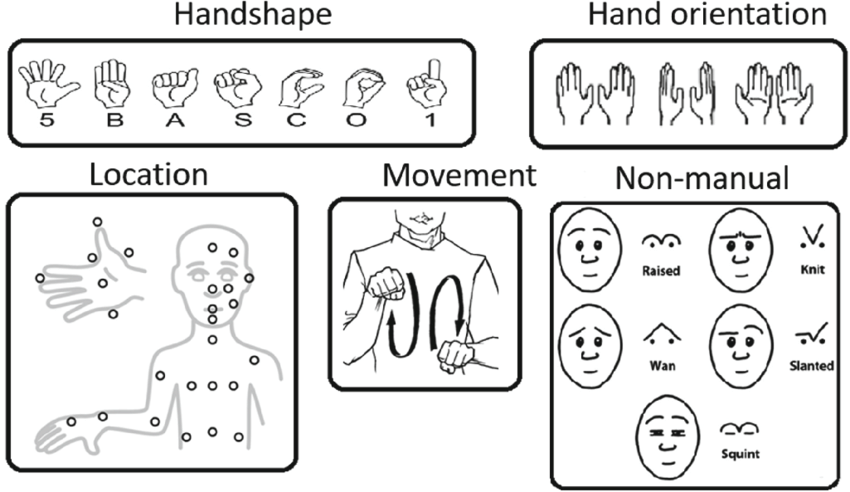
  • There are five formational parameters that make up each sign. These parameters can be combined in different ways to make meaning (handshape, orientation, location, movement, and non-manual signals). 
  • By using space, signers can show multiple ideas simultaneously (e.g. one hand can be used to show a person approaching someone at the same time as the other hand shows the other person sitting down). 
  • Understanding and using the five formational parameters that make up each sign in a range of contexts 

Five formational parameters used to form signs 

  • Handshape (the shape at the start of a sign) 
  • Orientation (the way the palms of the hands are facing at the start of the sign) 
  • Location (use of space — where the sign is articulated, either on the body or in the signing space) 
  • Movement (the direction, speed, repetition, and manner convey meaning in signing) 
  • Non-manual signals (NMS) (grammatical meaning made via systematic movements and expressions of the face, head, and upper body) 


Linguistic knowledge 

  • There are different greetings and farewells depending on context (e.g. formal, informal, time of day). 
  • Using basic greetings and farewells in different contexts 

Standard formulaic utterances for greetings 

  • Kia ora (informal) 
  • Tēnā koe (formal) 
  • Hi (informal) 
  • Hello (formal) 
  • Welcome | Haere mai (formal) 
  • How are you? 


Standard formulaic utterances for farewells 

  • Ka kite 
  • Kia pai te rā 
  • Goodbye 
  • See you later 

KIA ORA 

TĒNĀ KOE 

HI 

HELLO 

WELCOME | HAERE MAI (same sign, different mouth pattern) 

HOW-ARE-YOU 


KA KITE 

KIA PAI TE RĀ 

GOODBYE 

SEE YOU LATER 

Cultural and sociolinguistic knowledge 

  • In sign language, specific practices are used to gain a person’s attention such as flutter waves, shoulder taps, table taps, stomping, and flashing lights. 
  • There are unique ways to demonstrate social awareness, such as maintaining eye contact and showing understanding during greetings and farewells. 

Linguistic knowledge 

  • There are English sentence structures (imperatives and negative imperatives) that, when coupled with unique non-manual signals (NMS), communicate a range of simple classroom and instructional language in NZSL. 
  • Understanding and using a range of simple classroom language 

Imperatives 

  • Various instructions and commands 
  • Requests 


Negative imperatives 

  • Telling someone not to do something 


Appropriate non-manual signals 

  • Don’t know 

STAND, SIT, WATCH, LINE-UP, SEMI-CIRCLE 

BOOK, PLEASE HELP, PUT-away 


                      neg 

DON’T-DO-THAT 

                   neg 

DON’T-TOUCH 


                nms 

DON’T-KNOW 

Linguistic knowledge 

  • Greetings and introductions use consistent, formulaic sentence structures. 
  • There are unique sentence structures for communicating politely. 
  • Directions and instructions in NZSL make use of prompts to ensure contexts are understood appropriately. 
  • Using and responding to politeness conventions, directions, and instructions 

Standard formulaic utterances for: 

  • Thanking 
    • Thank you 
    • Ngā mihi 
  • Excusing oneself 
    • Excuse me 
    • Apologies 
    • Sorry 
    • That was my fault 

       
  • Directions 
    • To go to the toilet 


  • Instructions 
    • Everyone pick up rubbish (English) 
    • Kohia te rāpihi (Te Reo Māori) (signs are the same for NZSL and Māori Turi) 

THANK-YOU 

NGĀ-MIHI 


EXCUSE-ME 

SORRY 

my-FAULT 


            t 

TOILET, GO-to HALLWAY, TWO DOOR LEFT 


IX-loc PLAYGROUND, RUBBISH, YOU-all PLEASE  

PICK-UP

Linguistic knowledge 

  • NZSL uses the two-handed fingerspelling system to represent the English alphabet by applying handshapes and stress patterns. 
  • Fingerspelling is typically used for proper nouns, to describe unknown signs, or for subjects and objects that may not have a sign. 
  • Introducing themselves and others by fingerspelling their own name and the names of others 
  • Identifying the signs of each letter of the NZSL alphabet, using correct handshapes and stress patterns

Standard formulaic utterances for introductions 

  • I am Kelly, I am Deaf (English). 
  • Ko Hine ahau, he tangata Turi ahau (Te Reo Māori). 
  • Signs are the same for NZSL and Māori Turi. 


Fingerspelling 

  • Fingerspelling fs 


Personal pronoun signs (pointing signs) 

  • Such as IX-, ME, YOU, SHE, HE, THEY, KOE, KOUTOU 


Use of possessive adjective 

  • Such as MY, YOUR, HIS, HER, OUR, THEIR 

NAME IX-me fs-KELLY, ME DEAF IX-me 

NAME IX-me fs-HINE, ME MĀORI TURI IX-me 


NAME IX-me fs-RUA 

MY FATHER NAME fs-TAMA 

HER MOTHER NAME fs-PAULA 


HELLO MY NAME fs-RAPHAEL 

HIS NAME fs-MUHAMMAD IX 

(name sign) ________       

IX-he MAN NAME fs-SEMISI IX-he 


YOU SISTER, HER NAME fs-ANAHERA 

HIS BOOK RED 

THEIR FAMILY, ALL DEAF 

OUR WHĀNAU, FROM (place name) ________ 

Cultural and sociolinguistic knowledge 

  • Whenever a pronoun is signed, Māori Turi display an open palm as opposed to a pointing finger. 

Linguistic knowledge 

  • Non-manual signals (NMS) are crucial for expressing feelings and emotions as well as responding to questions about feelings and emotions. 
  • Non-manual signals (NMS) include facial expressions, head movements and body posture. 
  • Facial expressions are used to signal a question or to seek information. 
  • Communicating about feelings and emotions, including asking others how they are and responding appropriately when asked 
  • There are three main verbs: 
    • plain 
    • spatial 
    • agreement. 
  • Simple statements and questions come with some verb inflection and an emphasis on non-manual signals. 


‘Wh’ questions 

  • Questions that are open-ended and seek information usually include an interrogative sign or phrase (e.g. WHAT, WHO, WHERE, WHY, HOW, WHICH, WHAT-FOR, HOW-MANY, HOW-MUCH, WHAT’S-WRONG): 
    • eyebrows lowered into a slight frown 
    • chin/head slightly back or forward 
    • the last sign in the sentence being held briefly. 


Yes/no questions 

  • In questions that seek a yes/no answer, the sign order is the same as a statement, but the non-manual signals are different: 
    • direct gaze 
    • eyebrows raised 
    • chin/head slightly forward 
    • the last sign in a question being held momentarily. 

HOW-ARE-YOU?  

GOOD, ALRIGHT, BUSY, TIRED, HOT, COLD 

MY MOTHER EXCITED, SHE JUMP +++ (jump-for-joy)  

HER AUNTY SAD, CRY +++ 


                           whq 

HE GRUMPY, WHY? 


NEED DRINK WATER, ME THIRSTY. 

                           y/n q 

YOU WANT WATER? 

Linguistic knowledge 

  • Numbers are consistently structured using hand signs that follow five formational parameters (handshape, location, orientation, movement, non-manual signals). 
  • Learning how to use these parameters helps students communicate numbering processes clearly and accurately.
  • Communicating about basic concepts of number, age, size, shape, and colour 

Cardinal numbers 

  • 1–99 


Hundreds 

  • 100, 200, 300 … 


Thousands 

  • 1000, 2000, 3000 … 


Age 

  • Denoting ages of people 
  • Giving one’s age and asking how old someone is 


Size 

  • Height, weight, length 


Shape 

  • Basic shapes 


Colour 

  • Basic colours 


1, 2, 3 … 99 


100, 200, 300 … 


1000, 2000, 3000 … 


ME 12-AGE, MY SISTER, SHE 10-AGE 

                      whq 

HOW-OLD IX-you 


BIG, SMALL, TALL, SHORT 

fs-TOM TALL, fs-ROBERT SHORT 

HEAVY, LIGHT 


CIRCLE, SQUARE, RECTANGLE, TRIANGLE … 


RED, BLUE, YELLOW, WHITE, BLACK, GREEN … 

Linguistic knowledge 

  • Days of the week are communicated in NZSL using specific signs. 
  • Monday, Tuesday, Wednesday, and Friday are communicated with the handshape of the letter they start with (M, T, W, F). 
  • Thursday is marked differently, often blending T and H. 
  • Saturday and Sunday signs are unique, using a two-hands movement to represent the activities on the day rather than a letter-based sign (e.g. WASHING, CHURCH). 
  • Communicating about the time of day and days of the week 

Days 

  • Time of day 
  • Days of the week 

MORNING, NIGHT, TODAY, TOMORROW, YESTERDAY 

MONDAY, TUESDAY, WEDNESDAY … 

Cultural and sociolinguistic knowledge 

  • NZSL is part of Deaf culture — language and culture are interdependent and are critical to communicating with the local Deaf community, including Māori Turi. 
  • Communicating about self, identity, origin, and belonging includes specific signs that are representative of cultural and social connection to people, places, and whakapapa. 
  • There are some iwi and hapū names that do not have signs and are instead finger spelt. 
  • There are some iwi signs that do not include the ‘Ngāti’ or ‘Ngai’ prefix (e.g. Ngai Tūhoe is simply signed ‘Tūhoe’). 
  • Communicating about significant places such as: 
    • their hometown or place of family origin  
    • where they live  
    • the hometown and/or place of origin of others 
  • Identity: 
    • Where are you from?  
    • Deaf or hearing? 
    • Ko wai au? 
    • Nō hea/whea koe? 
    • Signs are the same in both NZSL and Māori Turi. 


  • New Zealand city names 

     
  • Iwi | hapū names 


  • Type of places 
    • countries 
    • buildings

FROM WHERE YOU? 

DEAF, HEARING, HARD-OF-HEARING, HALF-DEAF, CODA 

WHO? 

FROM WHERE? 


AUCKLAND, WELLINGTON, CHRISTCHURCH … 

NGĀPUHI, TŪHOE, NGĀTI AWA … 


AUSTRALIA, SAMOA, CANADA … 

HOME, SCHOOL, WHARENUI, MARAE … 

Linguistic knowledge 

  •  
  • Tense in NZSL is shown through time indicators (such as past, present, future) and is often established at the beginning of a sentence, with the rest of the sentence understood in relation to that timeframe. 
  • NZSL ordinal numbers indicate position or order in a sequence (for example 1st, 2nd, 3rd) and can be expressed using specific signs in NZSL that differ from cardinal numbers. 
  •  
  • Using simple narratives in the correct tense 

Establishing time markers 

  • Tense 
  • Clock times 
  • Ordinal numbers 

NOW, LATER, NEXT WEEK, LAST YEAR 

ONE-O’CLOCK, TWO-O’CLOCK, THREE-O’CLOCK … 

1ST, 2ND, 3RD … 

During Novice 2

Knowledge

The facts, concepts, principles, and theories to teach.

Practices

The skills, strategies, or applications to teach.

Language

examples

English text. 

Language

examples

English text with NZSL glossing. 

Cultural and sociolinguistic knowledge 

  •  
  • Deaf cultural norms require multiple interactions with a range of audiences, so that a growing repertoire of gesture and expressive body movements emerge, forming the basis for conversations. 
  • There are regional variations (similar to iwi dialects in te ao Māori) in NZSL that impact the way signers articulate or produce signs such as grammatical choices and vocabulary usage. 
  • There are some signing students who may not feel comfortable pointing. It is acceptable to point with a flat and extended hand to refer to the relationship of people and things. 
  •  
  • Using signs to communicate one-on-one, with a wider group of people within a school/home environment, including the use of Māori concept signs 
  • Examples of regional variation include different signs for words like HOSPITAL, NINE, and TRAIN: 
    • there is a known regional variation for the sign NINE, with Northern signers preferring one variant and Southern signers preferring another 
    • there are multiple variants for the sign HOSPITAL, with different age groups and regions preferring different versions 
    • the sign for TRAIN shows regional and age-related variations, with different signs used by older signers compared to younger and potentially differing between regions. 

NINE 

HOSPITAL 

TRAIN 

Linguistic knowledge 

  • There are different types of name signs which are typically given by Deaf people and are: 
    • descriptive 
    • word-based 
    • generic 
    • fingerspelled initials. 
  • Increased fingerspelling speed and accuracy is crucial for effective communication and literacy development, allowing for clear and efficient transmission of information. 
  • Fingerspelling smoothly and with increasing fluency 
  • Fingerspelling speed fluency 


MY FRIEND NAME fs-GRACE 

YOUR FATHER NAME fs-YOSEF 


Linguistic knowledge 

  •  
  • NZSL uses signs as the means to communicate and has no written form of expression. 
  • There are five formational parameters that make up each sign. These essential parameters can be combined in different ways to create meaning (handshape, orientation, location, movement, and non-manual signals). 
  •  
  • Using signs that demonstrate the five formational parameters confidently and competently 

Parameter changes

  • The five formational parameters are:
    • handshape
    • orientation
    • location
    • movement
    • non-manual signals (NMS).
  • When one of the five essential parameters changes, it changes the meaning of the sign, for example: FRIEND and MATE. These two signs are the same concept, but their signs have a different movement.

Linguistic knowledge 

  •  
  • There are simple sentences to describe physical characteristics and personality traits in sign. 
  • Intensifiers/adverbs emphasise a sentence and are often expressed through non-manual signals or changing the movement of a verb sign. 
  • The pronoun ‘it-IX’ (PRO) is a high-frequency word in NZSL and refers meaning for: 
    • contrasting objects and people relationships 
    • numbering referents 
    • referencing locations.
  •  
  • Exploring ways to describe people and everyday objects 
  • Common adjectives: 
    • to describe people 
    • to describe objects 
  • Plural pronouns 
  • Topic–comment 

                               t 

BOY HE, BLUE PŌTAE, NAUGHTY IX-he 


HIS GRANDMOTHER, (2h) ICL: hold a spade ‘gardening’, 

WORK-hard, SHE TIRED IX-she 


                 t 

IX-it CHAIR, (2h) DCL ‘chair with one leg broken’ 


WE, MĀUA, THEY, RĀTOU, YOU-ALL, IT-ALL 


                                    t 

IX-loc CITY, WHARE, nms-TALL

Cultural and sociolinguistic knowledge 

  • There are some signing student who may not feel comfortable pointing. This is especially true for Māori Turi. It is acceptable to point with a flat and extended hand to refer to the relationship of people and things. 

Linguistic knowledge 

  • Instructions may incorporate the use of list buoys to represent items or steps typically between one and five. 
  • List buoys are a grammatical structure used to organise and track multiple referents in a signed conversation. 
  • List buoys allow signers to break down complex ideas into simple, ordered parts, with each finger of the non-dominant hand representing a different item or step. 
  • List buoys are used where fingertips act as placeholders for nouns that are named or are about to be: 
    • the nouns ‘anchor’ items in a list 
    • once the fingertip is associated with a noun, it can be pointed to as a pronoun for future reference. 
  • Recognising and responding to classroom expressions and simple instructions 

Imperatives 

  • Various instructions and commands  
  • Requests 


Negative imperatives 

  • Telling someone not to do something 


List buoys 

  • To get ready for mathematics, please take out your:  
    • sign for ‘book’  
    • sign for ‘pen’ 
    • sign for ‘ruler’  
    • gesture of removing items from a bag or desk. 

STAND, SIT, WATCH, LINE-UP 

BOOK, PLEASE HELP, PUT-away 


                     neg 

DON’T-DO-THAT 

                   neg 

DON’T-TOUCH 


READY START LEARN MATHS 

PLEASE TAKE-OUT  

IX-index finger BOOK 

IX-middle finger PEN 

IX-third finger RULER 

Linguistic knowledge 

  • NZSL has specific sentence structures and formulaic ways of exchanging information, seeking clarification, and asking questions. 
  • Communicating about the relationship between people and objects, including using questions and statements for requesting, accepting, refusing, and declining 

Preform classifiers for people 

  • Singular 
  • Plural 


Questions 

  • Yes/no questions 
  • ‘wh’ question 


Plain verbs in the form of questions to make requests 

  • Formulaic ways of accepting 
  • Formulaic ways of declining 
  • Possessive and reflexive pronoun
  •  

MY FRIEND, SCL: 1 person 

‘approach-me’ 

ASSEMBLY FINISH, NOW (2h) PCL: 5 ‘line-up’ 


                                 y/n q 

BROTHER, HAVE IX-you 

               wh q 

PEN, WHERE  


                           y/n q 

ME PLAY, CAN IX-me 


                          y/n q 

BOOK, HAVE IX-you 


headnod-YES, WANT, THANK-YOU 


headshake-YES, NO 

                  neg 

wave-hand-NO 

             neg 

NOT-WANT 


TELL fs-TAMAR PICK-UP HER PAPER HERSELF, NOT-ME 

Linguistic knowledge 

  • NZSL uses spatial referencing (signing in different locations in space) to show the relationship between family/whānau members. 
  • Introducing family/whānau includes using specific markers and facial grammar to build authentic connection in signed conversations. 
  • Non-manual signals are important because they may show age, closeness, or affection. 
  • Gender markers are used (handshapes, movements, or placements near the face) to indicate whether a person is male or female. A gender marker may be omitted if a person’s gender is not known. 
  • Communicating about family/whānau members with appropriate facial grammar 

NAME IX-me fs-RUA 

MY FATHER NAME fs-PIERRE 

HER MOTHER NAME fs-PAULA 


HELLO MY NAME fs-RAPHAEL 

HIS NAME fs-MUHAMMAD IX 

(name sign) ______ 

IX-he MAN NAME fs-SEMISI IX-he 


                                           y/n q 

YOUR SISTER, HER NAME fs-ANAHERA? 

YOUR FAMILY, ALL DEAF? 

                               y/n q 

YOUR WHĀNAU, LIVE TARANAKI

Linguistic knowledge 

  • There are simple statements and questions with some verb inflection to communicate about personal information, wants and needs, and likes and dislikes. 
  • Communications about personal information, ownership, and needs have an emphasis on non-manual signs in NZSL. 
  • Communicating about personal information, ownership, and needs 

Questions 

  • ‘wh’ (content) questions 
  • ‘which’ (alternative) questions 


Topics are related to student interests 

  • Food 
  • Drink 
  • Clothes 
  • Transport 

                          whq 

MY APPLE, WHERE 


YOUR SHOES RED, GREEN,  

                            whq 

WHICH 


                            whq 

ME WANT GO-to SHOPPING. you-XI NEED WHAT? 


ME LIKE ICECREAM, SANDWICH, BANANA 

TOMORROW MORNING, WE WALK-to SCHOOL

Linguistic knowledge 

  • There are sentence structures that convey basic meanings and concepts of date as well as related events in sign. 
  • The typical sequence to communicate about the date is day + month + year. 
  • NZSL uses numbers 0–31 for days, 1–12 for months, and multi-digit numbers for years. 
  • Events are communicated by combining the date sequence with the sign about the event. 
  • Communicating about calendar dates and events 

Dates 

  • Calendar times and dates: 
    • months of the year 
    • birthdates 
    • ‘My grandfather was born in November 1954’ 
    • ‘Today is 14th August 2025’ 
  • Interrogative for date 
  • Seasons 
  • Events 

JANUARY, FEBRUARY, MARCH etc 

2nd JULY, 8th DECEMBER 2018 

MY GRANDFATHER BORN NOVEMBER 1954 

TODAY 14 AUGUST 2025 


                            whq 

TODAY, DATE WHAT 


SPRING, SUMMER, AUTUMN, WINTER 


23 JULY, BIRTHDAY ME 

25 DECEMBER — CHRISTMAS WITH WHĀNAU 

KINGS BIRTHDAY WEEKEND, JUNE EVERY YEAR 

CELEBRATE MATARIKI MĀORI NEW YEAR JUNE JULY  

EVERY YEAR 

Linguistic knowledge 

  • There are sentence structures that communicate and describe more complex concepts of a time when signing. 
  • Time in NZSL is communicated using number signs combined with the hour sign first then the minutes. 
  • The typical sequence is HOUR + MINUTE, followed by contextual cues if necessary (e.g. morning, afternoon, night). 
  • Hands and pointing can be used to indicate time conceptually on an imaginary clock.
  • Communicating about time and plans for the immediate future 

Time 

  • Digital time 
  • Basic time 
  • Break time 
  • Interrogative for time 
  • More complex time: 
    • clock signs 
    • past, present, future 
  • Questions and statements using future time 

1.45 (ONE ‘point’ FORTY FIVE) 

ONE-O’CLOCK, HALF-past SEVEN 

LUNCH, PLAY TIME, BELL 

                                     whq 

AFTER LUNCH, DO WHAT 


QUARTER PAST ONE 

QUARTER-to THREE 

TWENTY PAST SEVEN 

SCHOOL LUNCH TIME, 

HALF-past TWELVE 

TODAY LIBRARY OPEN, QUARTER-to TEN 


NOW, NEXT WEEK, LAST WEEK 

                t                 whq  

THIS SATURDAY, IX-you GOING WHERE?  

TOMORROW MY BIRTHDAY. CHRISTMAS HOLIDAY, 

                           y/n q 

GO-away CAN IX-you

Linguistic knowledge 

  • Sentence structures are more flexible in NZSL than they are in written languages. Background information (e.g. simple details about an event) can be given first, followed by more specific information, which may include negation signs. 
  • The most common non-manual signal when negating a statement is a headshake.  
  • Communicating simple narratives using negation signs 

Negation signs 

  • Negative quantity: 
    • NONE, NOTHING, NO 
  • Non-existence or non-possession of something: 
    • NOT, NEVER, DON’T 

                         neg 

FRIDGE NOTHING FOOD SO ME BUY MORE 

                       neg 

DRINK NOTHING ME 


                       neg 

COMPUTER NOT WORK, IX OLD 

               t   neg 

CHAIR-IX, NOT COMFORTABLE 

                          neg 

BRING WARM CLOTHES, DON’T WANT YOU WET COLD 

                          neg  

HIS COUSIN NEVER LIVE HERE, cousin-IX LIVE WELLINGTON IX 

File Downloads

No files available for download.