
NZC – New Zealand Sign Language – Emergent

This page provides the draft Learning Languages – New Zealand Sign Language Learning Area.

LearningLanguages-240.png

About this resource

This page provides the draft Learning Languages - New Zealand Sign Language Learning Area. The current Learning Languages curriculum can be found here The New Zealand Curriculum – Learning Languages.

Emergent phase

Teaching sequence

The following table exemplifies the knowledge and skills required for each mode when learning an additional language. The modes are closely connected, and learning in any one mode supports learning in the others.  

During Emergent 1, students will:

During Emergent 2, students will:

Watching

  •  
  • understand familiar sign language structures and vocabulary in new contexts  
  • make meaningful connections when new vocabulary occurs in familiar language contexts 
  • use assistive technology tools ethically and responsibly (e.g. NZSL dictionary, videos, captions). 
  •  
  •  
  • recognise and respond to the meanings and purpose of NZSL in familiar contexts 
  • recognise and respond to specific detail in dialogues, conversations, and reports. 
  •  

Signing

  •  
  • apply knowledge of vocabulary and structures to produce and respond to questions, instructions, and directions 
  • initiate and maintain conversations in sign. 
  •  
  •  
  • initiate and sustain conversations in sign 
  • demonstrate, in sustained presentations, their understanding of the sequencing and interaction of events  
  • communicate about a variety of topics in sustained conversations. 
  •  

Interacting

  •  
  • observe conversations in different contexts and take turns to role play  
  • role play dialogues that are used every day and demonstrate understanding with appropriate responses and appropriate actions  
  • use Deaf cultural strategies when communicating, such as gaining the person’s attention and asking others to repeat themselves. 
  •  

During Emergent 1

Knowledge

The facts, concepts, principles, and theories to teach.

Practices

The skills, strategies, and applications to teach.

Language

examples

English text. 

Language

examples

English text with NZSL glossing. 

Cultural and sociolinguistic knowledge 

  • NZSL and Māori concept signs are the primary means to communicate in one-to-one signed conversations. 
  • Principles such as recognising and producing basic signs, maintaining visual attention, using appropriate facial expressions and body language, and applying culturally respectful practices are fundamental to engaging well in a sustained signed conversation. 
  • Understanding culturally appropriate ways of communicating with Deaf people in a signed conversation 

Unique ways that Deaf people communicate 

  • Shoulder taps, stomping on the floor, banging on the table, switching lights on and off, and gently throwing something into their line of sight to gain attention 
  • Touching on the shoulder or upper arm is the most appropriate place to touch a Deaf person. 
  • Signing at a distance (you don’t always need to be in close proximity) 
  • Maintain eye contact in a signed conversation. The breaking of eye contact by hearing people is considered rude to Deaf people. For example, if a hearing person is distracted by a sudden noise and turns their gaze towards the noise, the Deaf person does not have access to that same sound, so is left wondering what is happening or what has happened. 

In NZSL classrooms when hearing people engage with a Deaf visitor 

  • Prepare questions in advance for the Deaf person, related to the content they are learning. 
  • Encourage structured interaction, games, and activities with Deaf people included in gatherings (such as an end of term ‘party’) where a Deaf person is invited. 
  • There is no need to over-enunciate mouthing — it looks like shouting to Deaf people.

Cultural and sociolinguistic knowledge 

  • Reviewing and self-reflection can be captured through digital or assistive technologies. 
  • Sign language is a moving language, not fixed like written languages, so capturing the language is signalled through video or visual means. 
  • Self-monitoring of progress is common when viewing or capturing one’s own work.  
  • Understanding the ethics of using tools to capture signed communication 

Ethical considerations 

  • Ensuring communication accuracy by being patient and allowing time for interpreters 
  • Maintaining confidentiality and privacy 
  • Using qualified professional interpreters to avoid misuse of sensitive information and incorrect relaying 
  • Respecting a Deaf person’s right to choose a preferred interpreter 
  • Understanding potential difficulties with overlapping communication in video relay devices 

Related vocabulary 

  • WATCH 
  • COPY 
  • RECORD 
  • CHECK 
  • SAVE 

Cultural and sociolinguistic knowledge 

  • Deaf people use varying signs to express the same concept. 
  • NZSL has internal variation for reasons that are specific to the history of the Deaf community. This internal variation includes intergenerational shifts and linguistic factors that result in growing vocabulary to reflect new concepts. 
  • Identifying and using simple signs to indicate past and present tenses and different parts of the country in a sustained signed conversation 
  • Using PAST 
  • Using NOW 
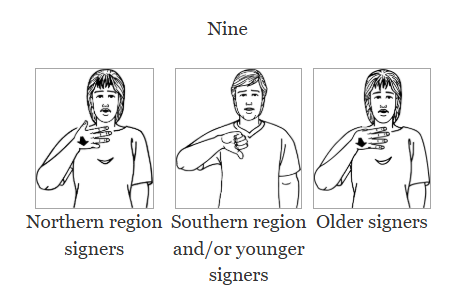
  • Using NINE  
  • Different signs for the same word in different parts of the country 

PAST, MY MUM GO SCHOOL-for-the-DEAF KELSTON, 

NOW, I GO DEAF AND HEARING SCHOOL 

Cultural and sociolinguistic knowledge 

  • There are culturally appropriate signs used to acknowledge relationships and show respect in formal situations. 
  • There are times when a two-step process of interpreting is necessary for Māori Turi in formal situations, first translating te reo into English, then English to NZSL. 
  • Similar to correct pronunciation of kupu Māori, correct signing of place names when communicating mihi and pepeha is fundamental in formal situations such as pōwhiri. 
  • An example of correct signing includes the sign for ‘Manukau’ in mihi and/or pepeha. Traditionally, the NZSL sign is man + cow. Through correction from Māori Turi, the updated sign is maunga + water (expressing relationship to Manukau Harbour).  
  • Using greetings and introductions to acknowledge relationships in formal situations 
  • Because there are few trilingual interpreters, there are occasions where you might have two interpreters (reo to English, English to NZSL) in the same place. 

Cultural and sociolinguistic knowledge 

  • There are specific signs and gestures, combined with facial expressions, to convey intended meaning and level of formality when requesting and offering in sign. 
  • The type of relationship between the people interacting determines the appropriate level of formality when signing. 
  • Requesting, offering, accepting, and declining things, invitations, advice, and suggestions 
  • Use of me-ASK-you to ask a question 
  • Use of SHOULDER-TAP-you to ask a question (of a third person) 
  • Accept and decline 

                          y/n q 

me-ASK-you PLAY OUTSIDE, WANT IX-you             


me-SHOULDER-TAP-you,  

                           y/n q 

RULER, HAVE IX-you 


                             y/n q 

TONIGHT, COME, CAN IX-you 

                              neg 

ME NOT-SURE, MAYBE ME HAVE ARRANGEMENT go-OUT 

Linguistic knowledge 

  • Classifiers combine handshapes and movements to represent the appearance, movement, and spatial arrangement of everyday things. 
  • Classifiers include a description of physical things, places, and actions and explain specific details of objects and physical processes. 
  • Understanding and using simple classifiers in sign language that describe and represent things in an everyday context 
  • Simple classifiers: 
    • handling classifiers  
    • object classifiers 

HCL press-button, CAR LOCK. 

CAR CL:  

Linguistic knowledge 

  • There is a structured system of handshapes and movements, hand/finger orientation, facial expression, lip patterns, and use of space to convey meaning in NZSL. 
  • Recognising and responding to more complex classroom instructions and directions, involving several steps 
  • Additional classifiers:  
    • size and shape classifiers 
    • location classifiers 
  • Sequencing  
  • Directions involving several steps in te reo Māori 
  • Noun–verb pairs 

WATER, DCL bottle 

PIZZA, DCL slice 


                      t 

SHELF, BOX ICL: ‘put on the shelf’ 


HĪKOI, turn-MAUI, TŌTIKA 

HĪKOI, turn-MATAU, IX-loc 

WHARE PUKAPUKA IX-loc


PAPER, to-FOLD 

SCISSORS, to-CUT 

Linguistic knowledge 

  • In NZSL, body language is important because it often carries grammatical information to convey meaning (e.g. role shifting and referential shift). 
  • Using context and familiar language to work out meaning and the relationships between things, events, and ideas 
  • Use spatial referencing to refer to preferences 

rs-left BASKETBALL, ME LIKE FAST GAME 

rs-right CRICKET, BORING, SLOW 

Linguistic knowledge 

  • Signers use a range of language features and strategies to explain and endorse their requests, demonstrating understanding of context and audience. 
  • Communicating about likes, dislikes, emotions, needs, and preferences in some detail, justifying where possible 
  • A range of vocabulary to do with feelings, emotions, likes, dislikes and needs 
  • Rhetorical questions 

MY FRIEND EXCITED, HER FATHER VISITING,  

BUT NEED CLEAN HOUSE IX-she, 

DON’T-LIKE CLEANING IX-she  


ME LIKE EVERY SATURDAY,  

                          rhq 

WHY, nms-SLEEP-IN, RELAX IX-me 

Linguistic knowledge 

  • In NZSL, events are communicated to reflect how they occur in real time. 
  • NZSL uses a topic-comment structure which differs from English. 
  • Communicating about events and experiences using time-related connectives 
  • Fingerspell proper nouns 
  • More complicated referential shift (rs) 
  • Use NMS (non-manual signals) to show causation 
  • Topic-comment structure with appropriate NMS 

                           rhq 

FAMOUS RUGBY PLAY, IX-he WHO, fs-TANA UMAGA 


HIS FAMILY LIVE fs-LYTTELTON 


referential shift (rs) 

ME SIT, SISTER SCL: 1 person 

‘approach me’ 


                    t               y/n q 

rs-sister SHOPPING WANT Ix-you 

rs-me LOVE GO 

rs-sister OK, PICK-UP WILL IX-me 

rs-me              whq 

          WHERE GO 

rs-sister GO fs-RICCARTON MALL 

rs-me PERFECT 


LAST WEEK, YOUR SISTER FINISH DRIVER LICENCE  

                                     neg 

PASS, BUT CAR, SHE CAN’T AFFORD IX-she 


                        t 

RUGBY LAST NIGHT, ME GO WATCH STADIUM, WAIKATO LOST 

Linguistic knowledge 

  • There are signs to represent specific weather conditions (e.g. sun, rain, wind, snow) and seasonal changes. 
  • Spatial relationships and movement are also important for conveying more complex information such as the direction of the wind or the intensity of rain. 
  • Communicating about the weather and seasons 
  • A range of vocabulary to do with weather and seasons 

WINTER TIME, SNOW++. NOT-SAFE DRIVE 


NEXT SUMMER, MY FAMILY GO HOLIDAY AUSTRALIA IX-there. SUN-blazing, CAN RELAX BOOK READ 

Linguistic knowledge 

  • In NZSL one can establish two or more referents in the signing space for non-present nouns when describing: 
    • groups  
    • items/physical things 
    • locations 
    • relationships between groups. 
  • Distinguishing a group can be shown by a list. 
  • In addition, the specific use of the fingertips gives emphasis to detailed items in the list. 
  • Communicating about the hometown of multiple family members 
  • Communicating about the place of sign language origin learning 
  • Family members 
  • Referencing 
  • Place of NZSL learning 
  • More complicated referencing points to refer: 
    • groups 
    • items 
    • locations 
    • relationships 

MY UNCLE XI MĀORI, MY AUNTY ix FROM TONGA ‘at the top of New Zealand’ 


IX-left, BALL CHEAP, IX-right, BALL EXPENSIVE 


ME LEARN NZSL FROM XI-SCHOOL XI-CHRISTCHURCH 


MY BROTHER BORN AUCKLAND IX-there BUT GREW-UP TARANAKI IX-there 


MY FATHER IX-he ONLY DEAF PERSON IN FAMILY IX-it, BUT GROW-UP LEARN NZSL IX-at SCHOOL. 

Cultural and sociolinguistic knowledge 

  • It is important for NZSL signs for Māori place names be represented accurately and in a culturally appropriate way. For example, traditionally, the sign for Manukau was man + cow. Through correction and validation from Māori Turi the updated sign is maunga + water (expressing relationship to Manukau Harbour).

Linguistic knowledge 

  • Deaf people use varying signs to express the same concept. 
  • Sign variation of different vocabulary being used in different regions of continues to evolve through historical and intergenerational shifts.  
  • NZSL has sign variation for reasons that are specific to the history of the Deaf community (e.g. age, region, gender). 
  • Using simple narratives for the past and present tense  
  • Signs made in past and present tense: 
    • BEFORE, PREVIOUS, LONG-AGO, UP-TO-NOW 
    • FROM-NOW-ON, NOW, ALL-OF-SUDDEN 

                              whq 

BEFORE ME LOOK-FOR+++, YOU GO WHERE 


UP-TO-NOW, IX-ME NOT SEE MY FRIEND. SUPRISE IX-me 


ALL-OF-SUDDEN, MY PĀPĀ WATCH-ME PLAY NETBALL FROM-NOW-ON

Linguistic knowledge 

  • There are different types of verbs to describe actions: 
    • plain 
    • agreement 
    • spatial. 
  • Agreement and spatial verb signs are inflected depending on the location of the grammatical subject and the object in the signing space.
  • Communicating about travel, including comparing and contrasting how people travel 
  • A range of vocabulary to do with methods of transportation 

ME BUS TO WORK 

MY WIFE CATCH TRAIN SEE AUNTY CITY IX-there 

MY SON GO SCHOOL, IX-he WALK IX-he 

During Emergent 2

Knowledge

The facts, concepts, principles, and theories to teach.

Practices

The skills, strategies, or applications to teach.

Language

examples

English text. 

Language

examples

English text with NZSL glossing. 

Cultural and sociolinguistic knowledge 

  • NZSL and Māori concept signs have basic signed vocabulary, sentence structure, formational parameters, and conversational strategies that support fluid interaction in signed conversations. 
  •  
  • Using signs to communicate with Deaf and hearing groups in basic and fluid signed conversations 
  • Interacting with a larger audience in sign (e.g. going to an event outside of school hours, attending ‘Deaf, Deaf World!’)  
  •  

Cultural and sociolinguistic knowledge 

  • In NZSL, describing states and feelings is highly expressive and relies on a combination of facial expressions and non-manual signals, as well as specific emotion signs to convey meaning. 
  • Describing states and feelings 

Cultural and sociolinguistic knowledge 

  • NZSL has its own ways of utilising figurative language to express ideas beyond literal meaning, including figures of speech. 
  • Figurative language is expressed visually through handshapes, movements, facial expressions, and body language. 
  • Exploring increasingly complex language to describe people, places, and events 

Linguistic knowledge 

  • There are different sign language styles across countries, regions, and individual homes (home sign). 
  • Recognising and using prescribed signs from other countries in a signed conversation 

Sign language manual alphabet in other countries 

  • The manual alphabet used for fingerspelling differs across American Sign Language (ASL) and New Zealand Sign Language (NZSL). 
  • ASL uses a one-handed manual alphabet. 
  • NZSL uses a two-handed manual alphabet, similar to British Sign Language (BSL) and Australian Sign Language (Auslan). 
  • Different styles are used whenever people from around the world meet for conferences, events, and activities related to Deaf people. 

Linguistic knowledge 

  • Opinions are often conveyed through facial expressions, which adds emotional tone and grammatical meaning in NZSL. 
  • Expressing basic opinions and judgements with reasoning 
  • Express thoughts and feelings 

ME THINK CAR TYRE FLAT 

NEED STOP CAR, HELP CHANGE TYRE, 

FEEL SAFE DRIVE 

Linguistic knowledge 

  • Classifiers in sign function similarly to visual pronouns or descriptors. 
  • They may show size, shape or appearance. 
  • They may show how something moves as well as where things are in relation to each other. 
  • Understanding and using increasingly complex classifiers in sign language to describe and represent things with specific context in the real world 
  • More complex classifiers — textural 

IX-COAT, FURRY, MAKE ME SNEEZE 

Linguistic knowledge 

  • In NZSL, factual explanations and instructions are structured using a combination of visual grammar, spatial organisation and non-manual signals to sequence ideas logically. 
  • Following and providing factual explanations, directions, and instructions while sequencing ideas logically 
  • Directions 
  • Listing using imperatives 
  • Rhetorical questions for reasons 
  • Ordinal numbers 
  • Prepositional phrases 

WALK-straight, TURN-right, WALK-downstairs 


IX-index finger BACKPACK, PUT-AWAY 

IX-middle finger MATHS BOOK, TAKE-OUT 

IX-third finger PEN, PAPER, READY 


                                   rhq 

PLANT IX-it GREEN, HOW, SUN 

nms-ABSORB IX NAME fs-CHLOROPHYLL, 

                                      nod 

MAKE CHANGE GREEN IX 


iX-loc CITY, BUILDING NAME fs-BNZ, 

MY FATHER WORK iX-loc 

5th FLOOR 


TUNNEL, TRAIN THROUGH 

TABLE, CAT SIT UNDER 

Linguistic knowledge 

  • There are specific signs that mark logical relationships, they include: 
    • SO / THEN — for logical connectors 
    • IF — for conditions 
    • WHY / HOW — for causes 
    • SO / THEREFORE — for effects or outcome. 
  • The most common way to connect clauses in NZSL is by using a ‘palms-up’ sign gesture between two clauses. This sign can mean ‘well, so, then, and, but, because, for’. 
  • Communicating about logical relationships (cause and effect, reasons and conditions) 
  • Sequencing:  
    • cause followed by result 
    • result followed by cause, with head nod 
  • Causative conjunctions: 
    • FROM, THROUGH 
  • Rhetorical questions: 
    • to give reasons and explanations 
  • Conditionals 

MY BABY, EAR SORE, ME WORRY++ 


                                                                                 rhq 

COMPETITION SCIENCE PROJECT YOU WIN HOW, 

                         nod 

WORK-hard IX-you 


ME FLU++, FROM WEATHER nms-CHANGE++ 


MY FATHER SERIOUS HURT THROUGH 

BAD ACCIDENT, ME UPSET, CRY++ 


                       rhq 

ME ANGRY WHY YOU LATE AGAIN++ 


      cond 

IF RAIN, CRICKET CANCEL 

Linguistic knowledge 

  • There are specific signs, time indicators, repetition and visual grammar to show regularity or repetitiveness. 
  • Repeating a sign (often with a slight bounce or rhythm) often shows an action is continuous or habitual. 
  • Communicating about habits and routines 
  • Basic adverbs of time, with a focus on frequency 
  • Attributive use of possessive pronoun 
  • Temporal aspect — habitual 

EVERY WEEK, CHURCH,  

ME nms-GO++ 


Fs-SALLY ALWAYS BUSY++, tend-to 


Me-TELL++iterative, GIVE-UP IX-me 

MEETING, ME GO++habitual 

Linguistic knowledge 

  • There are adjective signs (e.g. manner, degree) to represent specific weather conditions (e.g. sun, rain, wind, snow) and seasonal changes. 
  • Comparing and contrasting in NZSL requires mastering the visual vocabulary of signs and movements as well as the non-manual signals and cultural context that shape the language’s nuanced expression. 
  • Describing the weather and seasons 
  • Modifying adjectives and verbs in sentences: 
    • degree 
    • manner 

VERY-CLEAR-SKY 

VERY-HOT-SUN 

MUCH-SURFACE-FLOODING 


RAIN+attentively ‘mm’ (rain softly) 

RAIN+carelessly ‘th’ (rain continuously) 

RAIN+intensely ‘puff’ (rain heavily) 

Linguistic knowledge 

  • Combining visual–spatial grammar, classifier use, and non-manual signals are ways of describing, comparing, and contrasting places of significance, such as landmarks, cultural sites, or personal locations. 
  • Signers often use chronological or spatial sequencing to describe how a place has changed or how people move through it. 
  • Describing, comparing, and contrasting places of significance in developing detail 
  • Classifiers 
  • Contrasting two referents in the signing space 
  • Comparing using THAN 

LAST YEAR SPEECH COMPETITION 

PEOPLE (nms-puff face) (2h) PCL: ‘crowd’ 

THIS YEAR SPEECH COMPETITION 

PEOPLE (nms-puff face extreme) (2h) PCL: ‘crowd’ 


IX-left MATHS TEACHER IXa CLEVER 

IX-right ENGLISH TEACHER IXb SMART 

IXa GOOD TEACH 

IXb TEACH TOUGH 

IXa SOFT  

IXb STRICT 


IX-left SUPERMARKET, CHEAP THAN IX-right SUPERMARKET EXPENSIVE

Linguistic knowledge 

  • NZSL uses time signs at the beginning of a sentence or clause to show something is happening in the future. 
  • NZSL often follows a topic–comment or subject–verb–object structure. 
  • Using simple narratives in the future tense 
  • Signs made in the future: 
    • FUTURE, TOMORROW, NEXT WEEK, LATER, SOON 
  • Listing and sequencing 

NEXT WEEK, WHEN EXAM FINISH, 

Me-VISIT UNCLE, WILL IX-me, 

       rhq 

WHERE SOUTH ISLAND, 

      neg 

HAVE-SEE nms-LONG-TIME 


TOMORROW CHRISTMAS SHOPPING ME BUY++ 

IX-index finger PRESENT 

IX-middle finger CHRISTMAS TREE 

IX-third finger FOOD FOR FAMILY

Linguistic knowledge 

  • There are ways to express quality, quantity, and cost which involves understanding and using a mix of NZSL vocabulary, grammar structures, and non-manual signals. 
  • Communicating about the quality, quantity, and cost of things 
  • Quality of things 
  • Quantity of things 
  • Monetary amounts 

YESTERDAY, MY SON WON COMPETITION BEST DESIGN HOUSE. IX-he EXCELLENT JOB IX-he.  

           t  

GRASS, IX-it DOG EAT, YUK 


MANY PEOPLE (2h) CROWD CAFE, BUSY STAFF WORK-HARD 


FIVE DOLLAR TWENTY CENT ($5.20) 

FIFTY CENT (50c) 

File Downloads

No files available for download.